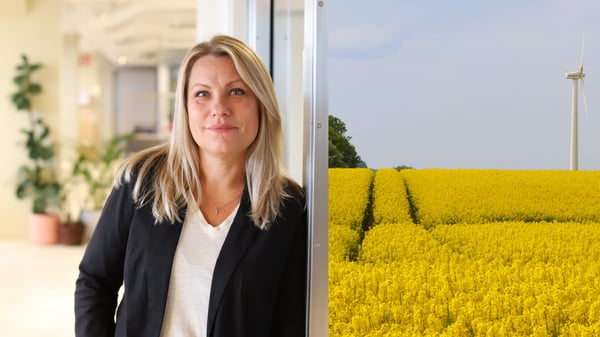
Real change only happens when strategies are put into action. That's the message when Henrik Fonahn from Stratsys and Bent Ekvern from Sopra Steria talk about the need to work data-driven with sustainability. The conclusion is that it is no longer a choice, but a prerequisite for success.
How can companies create real value from their sustainability efforts using data? Henrik Fonahn, ESG Manager at Stratsys in Norway, and Bent Ekvern, Head of Data-Driven Sustainability at Sopra Steria, will discuss the future of sustainability.
Sustainability as a business strategy
Most companies are currently in a time of rapidly growing sustainability requirements. EU regulations such as CSRD, the taxonomy and CSDDD are placing new demands on reporting and transparency. At the same time, national laws - such as the Norwegian Åpenhetsloven - are also affecting compliance requirements in the field of sustainability.
Henrik summarizes the situation:
- Omnibus is a bit like a ghost hanging over everyone involved in sustainability. Many companies are waiting to see what the right thing to do is. But there are good reasons to work data-driven with sustainability beyond what the regulations say. It is central to the ability to create value for both the business and its stakeholders.
Sustainability is fundamentally a data problem. Therefore, it is correct to let facts, figures and insights guide your decision-making instead of going on gut feelings. Only then can sustainability work become manageable, measurable and comparable. And thus strategically relevant for the entire organization.

Henrik Fonahn, ESG Lead, Stratsys Norway
Benevolence or value creation?
Henrik describes a development that is underway in many companies, where sustainability is gradually gaining a broader and more business-critical significance.
- Companies have long talked about sustainability in three dimensions - economic, social and environmental. But the work was often relatively disconnected from the core business. Today, sustainability is more about the opportunities created when these three come together. "Companies of the future will not be able to operate without proving that they can do so in a sustainable way," says Henrik.
In other words, sustainability has gone from being a sideline to becoming a business imperative. Successful companies are already integrating sustainability into their governance models, processes and systems - with data as the foundation.
Why data-driven - and why now?
The pressure on organizations to become more data-driven in their approach to sustainability is coming from many directions. EU regulations such as CSRD and CSDDD require transparency and verifiable impact data. At the same time, pressure is also increasing from national legislation, such as Norway's Transparency Act and the Swedish Public Procurement Act, where sustainability data is becoming a central part of supplier responsibility.
However, the demands are not only coming from legislators. Boards, investors, customers, banks and the media expect clarity, traceability and comparability in sustainability performance. In the midst of this, there is also a growing need for organizations to link sustainability goals to strategy, performance management and analysis.
Five-level systems
To meet these requirements, systematics and data quality are needed. Henrik emphasizes that system support should be based on five levels:
- Description. What has happened?
- Diagnosis. Why did it happen?
- Prognosis. What will happen?
- Recommendation. What should we do?
- Automation. "Do it for me."
Sustainability and GRC (Governance, Risk and Compliance) platforms can play a key role here. They make it possible to collect, structure and make visible data that can inform decisions.
The future of business
Bent has extensive experience in sustainability and digitalization. He helps organizations understand sustainability challenges from a business perspective.
- We have created a model that we call the Business of the Future, where we have identified the characteristics of organizations that succeed in making the transition. The elements of the model could be likened to pieces of cake in Trivial Pursuit. You fill your game board with the different parts of the model and set the ambition level," says Bent.
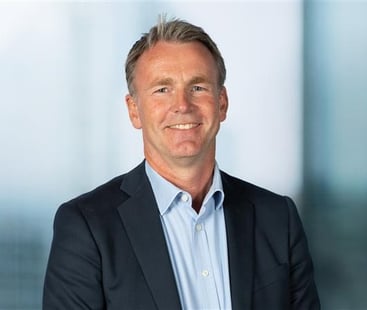
Bent Ekvern, Head of Data-Driven Sustainability, Sopra Steria
A successful business is according to the model:
- Sustainable. Takes responsibility, reduces environmental impact and acts socially.
- Value-creating. Drives innovation and customer value.
- Adaptable. Has flexible leadership and technology adaptation.
- Insight-driven. Works with quality-assured data, AI and analytics.
- Profitable. Optimizes resources and grows sustainably.
- Secure. Manages risks and cybersecurity.
"We are talking about data hunters"
Becoming data-driven is not first and foremost about technology, but about needs, according to Bent.
- Needs are the most important thing. Many start with internal data: do we have a clean house, how do we structure? But the big challenges arise in the value chain, where data is far away. This is a challenge in itself, we even talk about data hunters.
As more companies structure their sustainability data, it becomes easier to gather insights in one place. The point is not where your data is, but how it is used. With a comprehensive system support, data from different sources can be woven together into a holistic picture that supports analysis, target setting and reporting.
Six steps to the big picture
So how can companies get from the current situation to their desired target image? Bent describes a methodology in six steps:
- Current state. What works today?
- What are the needs? What should be prioritized?
- Architecture. How can technology support?
- A vision. A practical compass for the future.
- Roadmap. What, when and why?
- The cost. What resources are required?
To create results quickly, Sopra Steria uses a model consisting of three phases: Discover, Accelerate and Develop.
- The key is to test many different solutions to see what works for your particular business. Small, agile steps often yield faster results at a fraction of the cost," says Bent.
Henrik emphasizes that an important aspect is to concretize the way forward, in a way that includes sustainability, finance and IT managers. He describes the so-called success triangle. "Close cooperation between the head of sustainability, the CFO and the IT manager is crucial for success.
- When these three sit down and talk together, then things start to happen. It's all about taking ownership. Don't wait for someone else to realize the need. Build a business case that shows why this is important, and link it to the business - not just to compliance," says Henrik.
Five steps towards data-driven sustainability
A common barrier to working more data-driven is the perception that your data is not "good enough". Both Henrik and Bent believe this is a mistake.
- Don't wait for perfect data. Use what you have, it will get better over time. The important thing is to start collecting, structuring and visualizing, says Henrik.
They highlight five steps to working more data-driven in sustainability work:
- Double materiality. Understand how laws affect strategy, market and product design.
- Map regulations and requirements. From CSRD to CBAM.
- Identify what data you need. Both internally and in the value chain.
- Prioritize your data based on six questions. Why, how often, how much, how complex, are other actors needed, does it already exist?
- Establish roadmap, data governance and technical solution. Create a long-term structure.
From words to action
Bent and Henrik share the view that sustainability can no longer be run as a separate initiative. It must be an integral part of business management - just like finance and risk. With a data-driven approach, companies can:
- Streamline reporting and internal controls
- Get a better basis for decision-making
- Avoid misinvestment in systems
- Build internal understanding and engagement
- Create competitive advantage and a stronger brand
- It's all about moving from manual processes to a managed, data-driven whole. Then you get value for both the time and money spent on sustainability," says Henrik.
When the sustainability manager, CFO and IT manager work towards a common goal, a completely different force arises in the organization. Sustainability work then becomes an engine for innovation, profitability and long-term responsibility.
Access to Henrik's data tools. Fill in the form to access presentation slides and Henrik's tools for prioritizing and managing data (Norwegian language).

.jpg?width=600&height=600&name=iStock-1138669707%20(1).jpg)