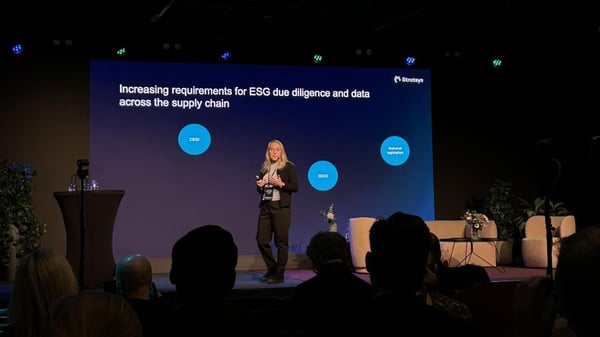
The global supply chain is becoming increasingly complex, while new regulatory requirements are emerging. Can procurement and sustainability managers meet the demands - without the workload spiraling out of control? Anna Lindstedt, ESG expert at Stratsys, argues that they can, pointing to three concrete steps to scale up their work.
As an ESG expert at Stratsys, Anna Lindstedt often sees how organizations struggle to systematize their sustainability work. When it fails, the pattern is often the same. The review is ad hoc, the organization becomes person-dependent and the long-term perspective is missing.
- There is no lack of good will. Many companies want to do the right thing, but still get stuck in solutions that don't really work, especially when it comes time to scale up. At that point, manual solutions are not enough. Excel and email threads aren't built to handle hundreds of suppliers and complex legal requirements.
The challenge is to create a structure that is both efficient and scalable. This is something that has come to the fore in recent years, as regulatory requirements increase.

Anna Lindstedt, ESG expert at Stratsys
The supply chain at the center
Once upon a time, it was common to see supply chains as a pure efficiency issue. Today, it's a central part of companies' sustainability and compliance efforts. With regulations such as the Corporate Sustainability Due Diligence Directive (CSDDD), the Corporate Sustainability Reporting Directive (CSRD), the EU Deforestation Regulation (EUDR) and the Norwegian Åpenhetsloven, expectations are being raised. Companies are now responsible not only for their own operations, but also for the actions of their suppliers.
The accountability of suppliers in turn results in new requirements for purchasing organizations. The requirements are becoming more numerous, broader and weightier:
- Growing supplier lists. Today, it is not uncommon to have hundreds or thousands of suppliers, at which point manual management is no longer practical.
- Broader regulatory framework. Climate impact, human rights, chemicals, working conditions - the list goes on. The audit should cover many dimensions.
- Confidence issue. A supplier scandal can quickly damage the brand and reduce both customer and investor confidence. A damaged brand can be very difficult to repair.
All in all, today's procurement organizations are dealing with completely new requirements, with the same resources as before.
- More requirements, more suppliers and greater expectations of transparency. It's this combination that makes the issue so complex, given that demands are rarely matched by a corresponding increase in resources. The equation may seem unsustainable - unless you're prepared to rethink, says Anna.
Identifying the pitfalls
So what are the common pitfalls for organizations conducting supplier audits today? One common problem is that the work is often fragmented in the absence of a coherent strategy. Anna points to four recurring problems linked to this:
- Inconsistency. When SAQs are handled manually, assessments often differ. Common Excel templates with open-ended answers are interpreted differently, resulting in uneven and incomparable results.
- Time-consuming. Manual handling of e.g. certificates, follow-ups and reminders quickly leads to an administrative bottleneck.
- Dependence on individuals. If a key person leaves, the organization loses both structure and history, leading to a lack of continuity.
Keys to scalability - in three steps
So, how can your organization build a way of working that can withstand the demands of today and tomorrow? Anna highlights three keys to sustainable supplier auditing:
- Standardized processes. When everyone does things in their own way, auditing becomes difficult to follow up. Therefore, it is crucial to establish uniform procedures for making risk assessments, following up on deviations and documenting supplier data.
- Digitized workflows. Bring in digital system support that gathers all supplier data in one place, automates reminders and provides real-time overview of risk levels. This increases the quality of work and makes it easier to prioritize resources.
- Plan for scalability. Many solutions work for a small supplier base, but fail when the list grows to hundreds or thousands of suppliers. Make sure the solution can handle global supply chains and integrate with other systems.
The result of planning for scalability is less administration, faster processes and fewer mistakes. As a procurement department, you'll have more time for strategic work, while scaling up.
- Standardization not only reduces duplication. It also allows you to present a consistent basis to management, investors and regulators. This is a hygiene factor for building trust," says Anna.
Reading tip: Collaboration between procurement and sustainability - a strategic success factor
From compliance to value creation
It's easy to see supplier auditing as just another compliance requirement. However, Anna argues that it is a perspective that is useful to turn around.
- Building a scalable process not only helps to bring order to your work, which is good in itself. It also gives you a clearer picture of who your suppliers are, not least their strengths and weaknesses. This allows you as an organization to work more proactively and strategically.
By gathering supplier data in one place, it becomes easier to identify where the risks are and who the risk suppliers are. This also makes it possible to see which suppliers are at the forefront of sustainability work and which can become important partners.
Stronger without more staff
As we have discussed, a scalable supplier audit can be said to be built on three pillars - three keys to scalability. Standardization, digitization and scalability together allow the procurement organization to meet today's demands and get ready for tomorrow, without necessarily having to increase staffing levels.
As an organization, it is clear that a scalable structure means that the organization is stronger for future regulations. It also means that a greater focus can be placed on value-creating activities.
Trust, efficiency and competitiveness
Fundamentally, it's about embracing a new and different approach. About not seeing supplier auditing as a matter of ticking off requirements, but as a matter of building trust and resilience. By standardizing, digitizing and scaling up the work, organizations can both save time and be better equipped for the demands of the future.
Perhaps the single most important piece of this puzzle is a solid system support, because when used correctly, it helps you with all three of these keys. It allows you to unify processes, automate flows and create the transparency that customers, owners, authorities and partners demand.
- Companies that see supplier auditing as a strategic issue rather than an administrative burden will not only meet regulatory requirements. They will gain in trust, efficiency and competitiveness," concludes Anna.
See how Stratsys can help you take the next step in sustainability: Read more about ESG Due Diligence.