Connecting products with suppliers
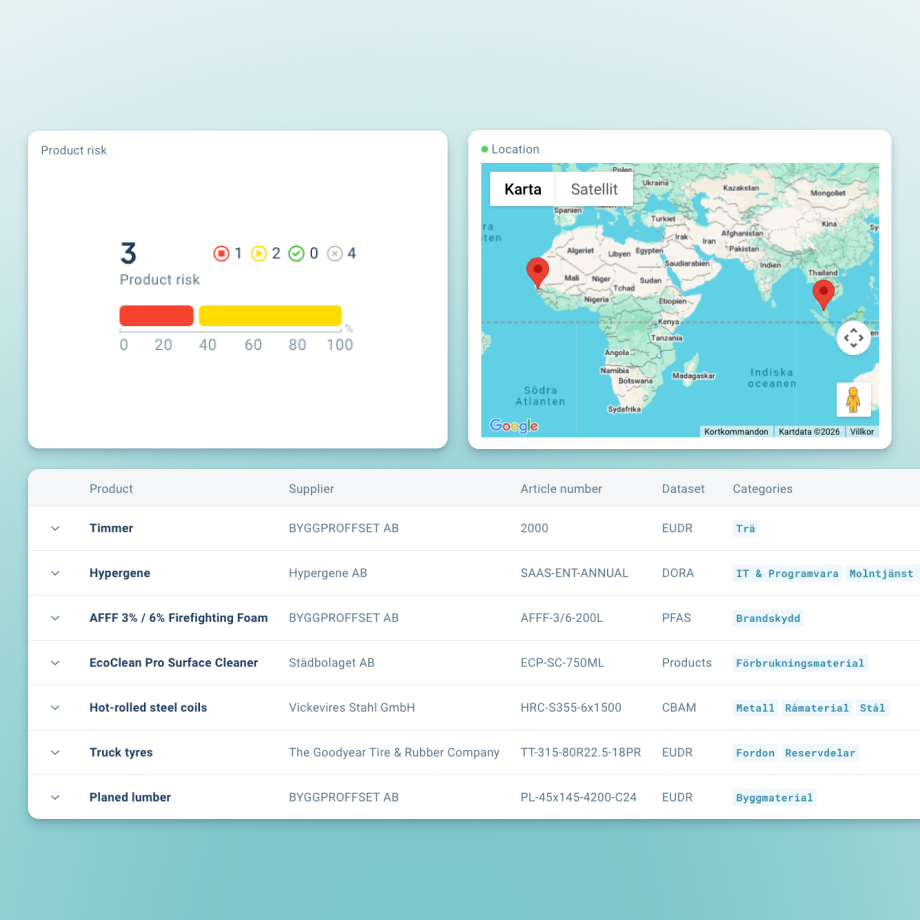
Connect products with suppliers, collect different types of product data - such as certifications and country of origin - and conduct product-level risk assessments.
ESG Due Diligence - Product assessment
When product and supplier assessment are combined, the risks become clear, and you can act where it makes the most difference - for a more sustainable value chain.


Connect products with suppliers, collect different types of product data - such as certifications and country of origin - and conduct product-level risk assessments.
Get a clear due diligence process in a common platform that simplifies work and makes compliance, such as EUDR and CBAM, a natural part of how you work.
Demonstrate to customers and stakeholders that risks are actively managed and responsibilities are clear - through documented and traceable work.

Phase 1
Build the structural foundation for product due diligence by setting up the relationships, collecting the data and conducting the risk assessments needed to begin operating at product level.
Phase 2
Enable the connections needed to track, document and demonstrate product risk, conduct assessments across product portfolios, and respond to evolving regulatory requirements.
Phase 3
Automate key due diligence tasks to reduce manual effort and conduct product risk assessments with the consistency and traceability needed to support different compliance requirements.
Many regulations place increasing demands on control over products, materials, and supply chains. With structured product assessment, it becomes easier to gather the right documentation, strengthen traceability, and support compliance work. Here are some examples of relevant regulations:
EU Deforestation Regulation requires companies to demonstrate that certain raw materials and products do not contribute to deforestation. It increases demands for traceability, risk assessment, and documentation.
Carbon Border Adjustment Mechanism is the EU's mechanism for carbon pricing on imports of certain goods. The regulation aims to manage embedded emissions and requires reporting of climate impact.
EU Forced Labour Regulation aims to prohibit products linked to forced labour from the EU market. It increases requirements for insight, risk management, and controls within the supply chain.
Digital Product Passport is intended to make information about a product's content, origin, and sustainability more accessible. The aim is to strengthen transparency, circularity, and more informed choices.
Registration, Evaluation, Authorisation and Restriction of Chemicals is the EU's chemicals legislation. It regulates chemical substances in products and materials to protect human health and the environment.
Packaging and Packaging Waste Regulation is the EU's regulation on packaging and packaging waste. It aims to reduce waste, promote circularity, and set clearer requirements for the design of packaging.
Want to know more about how you can work with product and supplier assessments in Stratsys? Contact us and we’ll show you how.